The account the client forgot to mention: a tracing playbook
Opposing counsel surfaces a statement at deposition. The litigation tilts before merits are argued. Here is the retrieval workflow that ends that class of motion for HNW divorce firms.
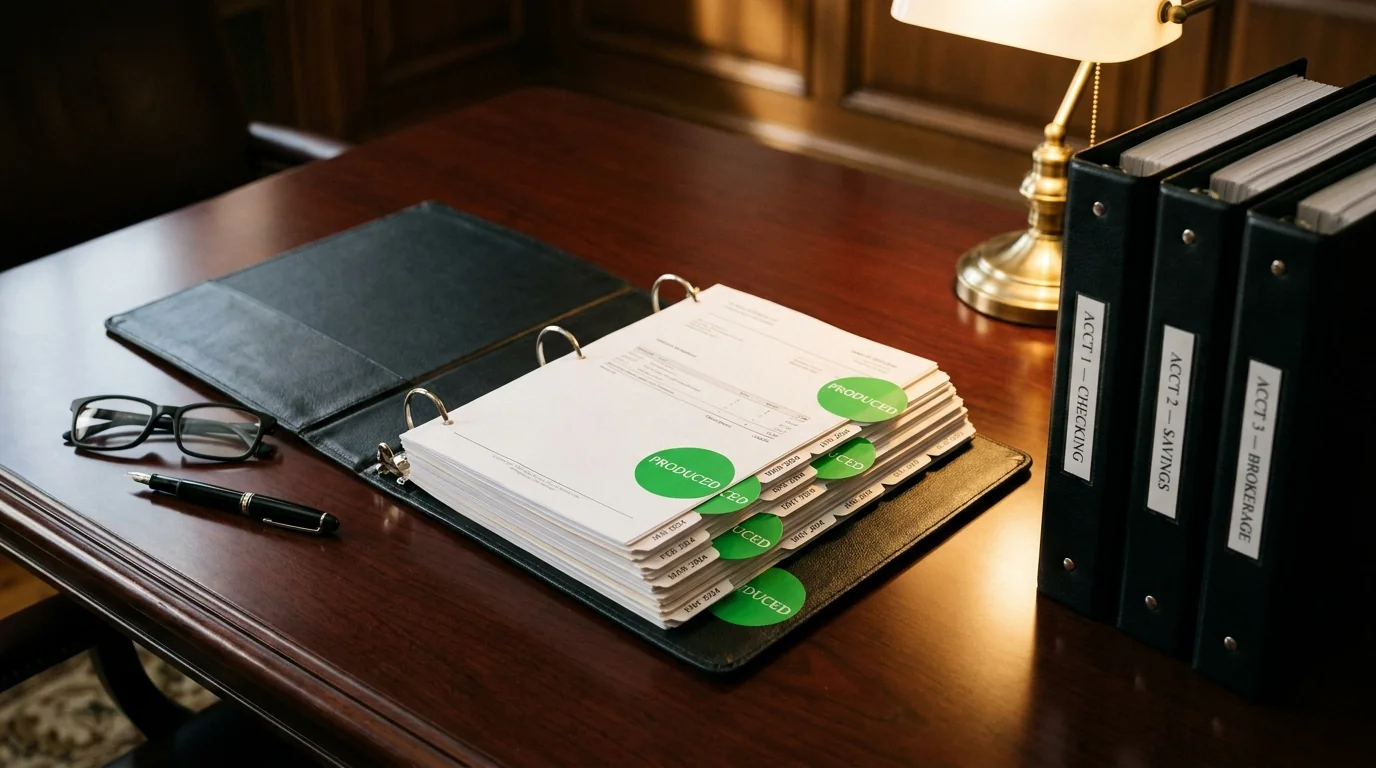
It happens at minute 47 of a deposition. Opposing counsel slides a statement across the table. Your client’s name. An account they never disclosed. The merits of the case haven’t been argued yet, and you’re already losing. Anyone who has practiced family law at the high-net-worth tier has seen this happen, and almost everyone has lost a client moment to it. This post is about the workflow change that ends it.
The two failure modes in family-law tracing
There are two ways the financial picture goes wrong before discovery closes:
- The forgotten account. Your client has a money-market sweep at a bank they haven’t actively used in three years. It is, in their head, “not really” an account. Until someone surfaces it.
- The lapsed portal. The account is disclosed, but the firm’s access to retrieve statements has expired: old credentials, password change, MFA device replaced. The information exists; you just can’t get to it without a back-and-forth with the client that takes a week.
Both failures share a root cause: the firm is reactive about retrieval. Statements get pulled when someone asks for them. Discovery requests, depositions, settlement negotiations: these trigger the work. By then, the timeline is short and the gaps are expensive.
“The point isn’t to retrieve more. The point is to retrieve before opposing counsel does.”
What discovery actually requires you to produce
In most jurisdictions, financial disclosures in divorce require the institution’s statement, typically 12 to 36 months back, occasionally further depending on the state and the matter. The acceptable form is the bank’s document, not a transaction summary, not a downloaded CSV. Forensic accountants and tracing experts work exclusively from the statement because the chain of custody runs through the bank.
Which means: a workflow that produces statements automatically, on a schedule, for every disclosed account, against every month of the relevant window, with consistent naming and folder structure: that workflow is not just operationally useful. It is the format the rest of the litigation team needs to do their work.
The retrieval-first workflow
The change we recommend at HNW family-law firms is to flip the order. Instead of retrieve-when-asked, retrieve-before-asked. The day a new matter is opened and disclosed accounts are intake’d, the retrieval starts. Every disclosed account, every month back to the relevant date, into the firm’s storage with consistent naming. By the time the discovery request is drafted, the production set is already assembled.
The upstream workflow looks like this:
- Intake. Client lists every account they remember. The firm’s intake form should specifically ask about old accounts, sweep accounts, brokerage sub-accounts, joint accounts, accounts at the spouse’s bank. Treat the intake as a retrieval brief, not a disclosure form.
- Authenticate. For every account, choose the right credential model. If your client is cooperative and willing to share access: firm-held credentials. If your client is reluctant, or if the spouse owns the account: Client Connection Link, where the account holder authenticates on their own device, and the firm never sees the password.
- Pull the historical window. Pull whatever the bank’s portal has in a single batch, not month-by-month as discovery moves forward. Most banks expose up to 24 months online, though it varies by institution; anything the matter needs beyond that goes through the bank’s records department, not automated retrieval (see below).
- Continue on schedule. Statements continue to post during the proceeding. Pull weekly. The financial picture should be current to within seven days at any moment of the case.
Multi-year archive, beyond the bank’s portal
A wrinkle most family-law firms hit: most banks purge online statement history at 12–24 months. So when a 36-month tracing request comes in for an account that has only 14 months in the portal, the firm is now writing letters to the bank’s records department asking for the missing 22 months: a process that often takes 4–8 weeks and can be charged at custodial-records rates.
The retrieval-first workflow side-steps this. If you start pulling on day one of the matter, you’re filling the firm’s archive in real time. By the time the older statements would have been purged from the bank’s portal, you already have them. They live in the firm’s storage, indefinitely.
Client Connection Link for cooperative spouses
The credential question is where most retrieval workflows in family law fall over. The client signed a release for their own accounts; they cannot release the spouse’s. For many cases (particularly amicable splits, mediation-led matters, and post-decree modification work) the spouse is willing to authenticate their own accounts. They are not willing to type their password into your firm’s intake portal, and they are not willing to email you a 2FA code.
Client Connection Link is the answer. The firm sends a secure link to the spouse. They tap it on their phone, authenticate with their bank, and walk away. No credential is shared. No password lives in the firm’s system. Statements flow into the firm’s storage from that point forward, on the schedule the firm sets. The spouse can revoke the connection at any time. Most don’t. The arrangement reads as fair to both sides because, materially, it is fair to both sides.
Naming and the tracing-expert handoff
The forensic accountant or tracing expert your firm hires bills at $300–$600/hour. The first thing they do with a production set is normalize it: rename the files, sort them by institution and account, fix dates that were captured inconsistently. Every hour they spend on cleanup is an hour they’re not spending on the actual analysis your client is paying for.
Statements pulled through DocGenie arrive with consistent naming (date, institution, account type) and folder-by-institution structure. The handoff to the tracing expert is the production set itself, with no cleanup. We have heard this back from forensic accountants directly: clean naming structure removes 4–8 hours of pre-analysis from a typical tracing engagement.
Security review for legal IT
The other reason firms historically can’t move to a retrieval-first workflow: security. The IT and risk teams at HNW boutiques will not approve a system that asks the firm to type client bank passwords into a third-party platform. Reasonable position. The standard answer to that posture:
- Read-only credentials. DocGenie can never move money or change account state.
- No stored credentials with Client Connection Link: the credential lives only in the bank’s session, never in the firm’s tenant.
- SOC 2 aligned controls, hardware-backed credential enclave for firm-held credentials, Chubb cyber insurance policy.
- Documentation available to the firm’s security reviewer under NDA before signing.
Lead with these. Do not bury them in an FAQ. The firms that have signed Enterprise contracts with us did so after the security review, not before. Make the review easy.
Closing
The point of this workflow is not productivity. It is control. A partner walks into a deposition having already produced every statement, with the historical window already filled, with every account already on the desk. Opposing counsel cannot surface what’s already been produced. The matter is argued on merits, not on whether you are still chasing your own client’s documents.
That feeling, never being ambushed in a proceeding by a number that should have been on the desk three weeks ago, is what HNW partners describe to us as the actual ROI. The hours saved are real. The control is what changes how the practice feels.
Stop chasing this month's statements.
Free for 2 connections, 3 credits a month — enough to pull Amazon and Capital One every cycle. No card.