The documents department is not supposed to be your bottleneck
500 filings a month × 10–15 accounts × 6–24 months of pre-filing pulls. Why a department-shaped fixed cost still becomes the cap on filing cadence, and what changes when it doesn't.
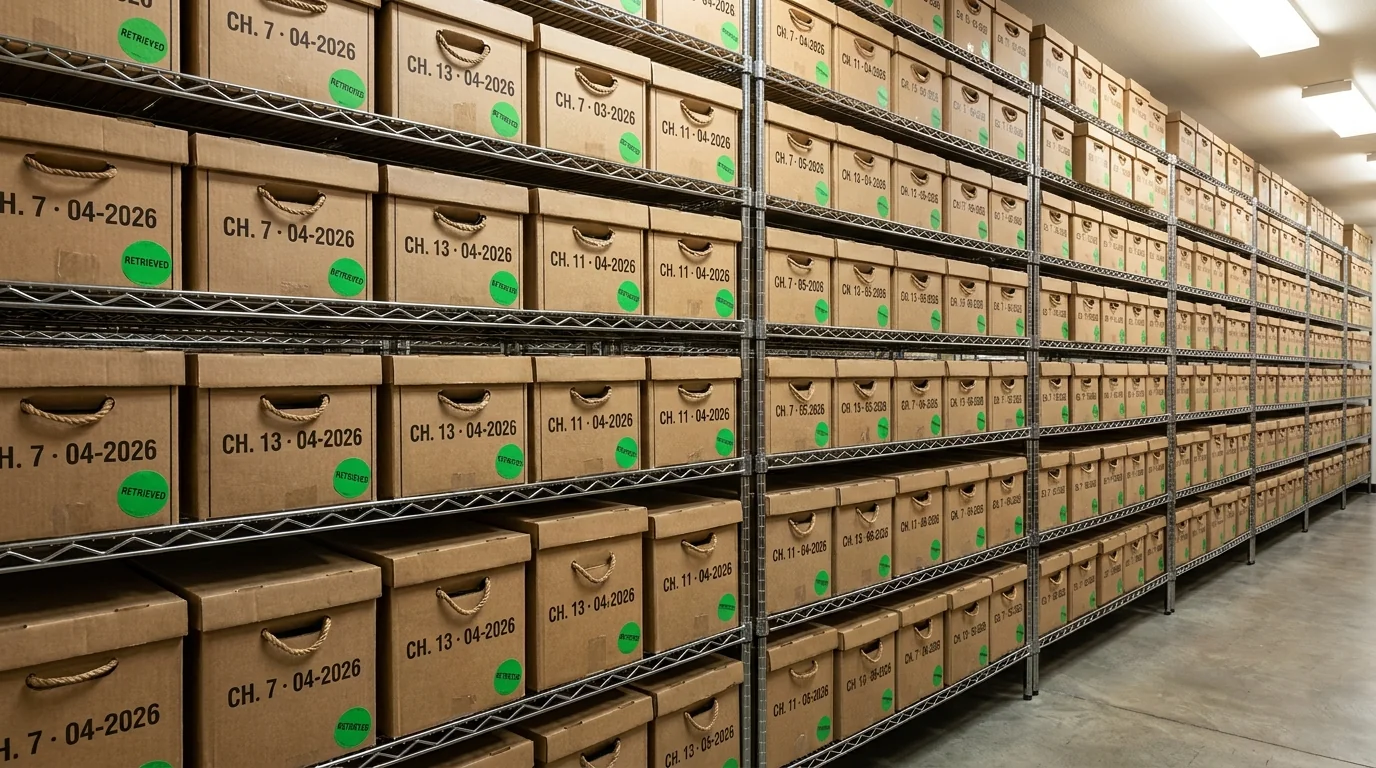
At a 100-staff consumer-bankruptcy firm filing 500+ Chapter 7 and Chapter 13 cases a month, the documents department is a fixed cost: about $400K a year fully loaded. It is also, at most firms we’ve talked to, the bottleneck on filing cadence. That’s not a department problem. That’s a workflow problem upstream of the department.
The math of pre-filing retrieval
A typical Ch. 7 or Ch. 13 petition requires statements from each of the petitioner’s financial institutions covering the months prior to filing. Six months at minimum; 24 months for some districts and trustee profiles. At the firm scale we’re describing:
- 500 filings per month
- 10–15 accounts per petitioner (checking, savings, credit cards, brokerage, retirement, joint accounts)
- 6–24 months of pre-filing statements per account
Multiply through. The lower bound is 30,000 statements per month. The upper bound is 180,000. Even at the median, this is a retrieval operation that requires the equivalent of dozens of full-time staff if it’s done by hand. Which is why every firm at this scale has a documents department in the first place.
Why Plaid won’t work here
Several firms we’ve talked to have evaluated Plaid for this. The answer back has been the same every time: Plaid delivers asset-summary PDFs, and the United States Trustee Program requires the institution’s actual statement. Asset summaries are disqualifying. This is not a margin call. It’s the rule the trustee enforces in every district we’ve seen.
The team at one Texas firm we work with verified this on a sample case before adopting DocGenie: the Plaid summary was rejected; the institution PDF was accepted. After that, the conversation about asset summaries ended.
“The court doesn’t care that the data is correct. It cares that it came from the bank. Aggregator summaries fail that test by definition.”
The four hours per case that disappear
Across the firms we’ve talked to, the per-case retrieval load (measured in human hours) is somewhere between 3 and 6 hours, depending on how cooperative the petitioner is and how many of their institutions require 2FA the petitioner has to relay. At 500 cases a month and 4 hours each, that’s 2,000 hours a month, roughly 12.5 FTE.
Most of that work is mechanical: log in, navigate to statements, download each month, rename, file. A small portion is judgment work: figuring out whether a particular account requires retrieval at all, handling oddball institutions, dealing with petitioners who can’t remember a password. The mechanical portion is the bulk of the load and the part that disappears entirely with automated retrieval.
What changes when the bulk of retrieval is automated
The most useful question to ask: what does a documents department look like once it isn’t doing the mechanical pull? At the firms we work with, the shift looks like this:
- Department headcount stays the same. This is not a layoff story. The work changes; the staff stays.
- Filing cadence increases. One firm we work with reported a 30% increase in filings per month with the same headcount. The department was not the gating factor on growth anymore.
- Quality of review improves. When the team isn’t logging in and downloading, they’re reading the statements and flagging issues a paralegal or attorney needs to address. They become the first line of file review, not the first line of file retrieval.
- Petitioner experience changes. Client Connection Link removes the credential ask from the intake conversation. Petitioners are uncomfortable typing bank passwords into a law-firm intake form; they are not uncomfortable tapping a link to authenticate with their bank directly.
Closing
The documents department isn’t supposed to be the bottleneck. At most consumer-bankruptcy firms it is, because the firm built a department to absorb a workflow problem rather than fix the workflow. The fix is upstream: automate the retrieval, route to the right destination, free the department to do review and intake.
The math works. The firms that have made the change have moved their bottleneck somewhere else, usually to attorney availability, which is the bottleneck a firm wants to have.
Stop chasing this month's statements.
Free for 2 connections, 3 credits a month — enough to pull Amazon and Capital One every cycle. No card.